Hannah Becher und Paula Muhr
Afterimage:
Deconstructing Memories
27.08.
Eröffnung: Do 27.08.2026 • 19:00 Uhr
Ausstellung: 28.08. – 30.08. • täglich 16 – 19 Uhr
Afterimage: Deconstructing Memories
Laut dem Cambridge Dictionary ist ein Nachbild ein Bild von etwas, das man weiterhin wahrzunehmen scheint, obwohl man nicht mehr darauf blickt oder obwohl es nicht mehr vorhanden ist. Hervorgebracht durch eine vorübergehende Anpassung des visuellen Systems, ist das Nachbild keine Reproduktion dessen, was gesehen wurde, sondern eine transformierte Spur von etwas, das nicht mehr präsent ist. Der Begriff kann auch als Metapher für Erinnerung dienen, da unsere Erinnerungen aus sich verschiebenden, fragmentierten Eindrücken der Vergangenheit bestehen, die durch Verlust, späteren Erfahrungen und Imagination geprägt sind. Die Ausstellung Afterimage: Deconstructing Memories untersucht die Beziehungen zwischen Sehen und Erinnern, indem sie zwei künstlerische Positionen zusammenführt, die sich mit der Präsenz verstorbener Eltern durch die Bilder auseinandersetzen, die nach ihnen geblieben sind.
In der Serie Blaues Gedächtnis transformiert Hannah Becher Fotografien von Pflanzen, die ihre Mutter in dem von ihr über viele Jahre kultivierten Garten aufgenommen hat, in Cyanotypien. Durch die physische und prozesshafte Auseinandersetzung mit diesem Archiv überführt sie diese persönlichen Bildzeugnisse in neue visuelle Formen. Erinnerung fungiert in diesem Gefüge nicht als exakte Wiederholung dessen, was sich einst ereignet hat, sondern als ein konstruierendes Zeugnis, das durch eine zeitlich aufgeschobene Reinszenierung hervorgebracht wird. Die so entstehenden Arbeiten beleuchten den Umstand, dass jedes Erinnern fragmentarisch sein muss und nur ein Echo eines Ereignisses darstellt, dessen Wahrnehmung bereits im Moment des Erlebens durch Zeichen und Bildsprache geprägt wird.
In ihrer neuen Arbeit Tata, Gone (2026) verbindet Paula Muhr Familienfotografien, Aufnahmen, die sie über mehrere Jahrzehnte von ihrem Vater gemacht hatte, seine eigenen Schnappschüsse, neu entstandene Bilder sowie narrative Reflexionen über ihre Beziehung zu einer sich fortlaufend entwickelnden multimedialen Installation. Ihr Ziel ist es nicht, ein geschlossenes Porträt ihres Vaters, mit dem sie sich wiederholt in ihren früheren Arbeiten beschäftigt hat, zu rekonstruieren. Vielmehr ist es ihre Absicht die Brüche, Leerstellen, verpassten Möglichkeiten und die anhaltende Sehnsucht nach Verbundenheit nachzuzeichnen, die ihre Beziehung zu ihrem Vater auch nach seinem Tod prägen. Anstatt Zugang zu ihrem zeitlebens und nun endgültig abwesenden Vater zu ermöglichen, werden Bilder zu einem Ort der Neubefragung von Identität, konflikthaften Familiennarrativen und generationenübergreifenden Schweigen.
Durch Prozesse der Auswahl, Übersetzung und Neukonfiguration setzen beide Künstlerinnen die Bildproduktion als eine Form der Dekonstruktion von Erinnerung ein, um zu untersuchen, wie unsere Erinnerungen an die Vergangenheit durch die Auseinandersetzung mit materiellen und mentalen Bildern weiterhin geprägt werden – Bildern, die zugleich fortbestehen und sich fortwährend verändern.
Afterimage: Deconstructing Memories
According to the Cambridge Dictionary, an afterimage is “an image of something that you seem to see when you are no longer looking at it or when it is no longer there.” Caused by a temporary adaptation of the visual system, the afterimage is not a reproduction of what was seen, but a transformed trace of something that is no longer present. The term can also serve as a metaphor for memory, as our recollections consist of shifting, fragmented impressions of the past, shaped by loss, subsequent experiences, and imagination. The exhibition Afterimage: Deconstructing Memories explores the relations between vision and remembrance by bringing together two artistic positions that engage with the presence of deceased parents through the images that remain after them.
In the series Blue Memory, Hannah Becher transforms photographs of plants that her mother took in the garden she had cultivated over many years into cyanotypes. Through a physical and process-oriented engagement with this archive, she transforms these personal visual records into new visual forms. In this context, memory functions not as an exact repetition of what once transpired, but as a testimony produced through temporally deferred reenactment. The resulting cyanotypes bear witness to the fact that each memory is unavoidably fragmentary and is merely an echo of an event whose perception has already been shaped by signs and visual language at the very moment we experience it.
In her new work, Tata, Gone (2026), Paula Muhr combines family photographs, images she had made of her father over decades, his own snapshots, newly produced images, and her narrative reflections on their relationship into an evolving multimedia installation. Her aim is not to reconstruct a stable portrait of her father, on whom several of her previous works had focused, but to trace the ruptures, absences, missed opportunities and continued longing for connection that characterise her relationship with her father even after his death. Rather than providing access to her perennially and now permanently absent father, images become a site for rethinking identity, fraught family narratives, and generational silences.
Through processes of selection, translation, and reconfiguration, both artists use image-making as a way of deconstructing memories to explore how our recollections of the past continue to be shaped through our engagement with material and mental images that both persist and keep changing.
________________
Sasha Pas, Protey Temen
RADIANTS, REPETITION
10.09.
Eröffnung: Do 10.09.2026 • 19 Uhr
Ausstellung: täglich 11.09. – 14.09. • 16 – 20 Uhr
Radiants
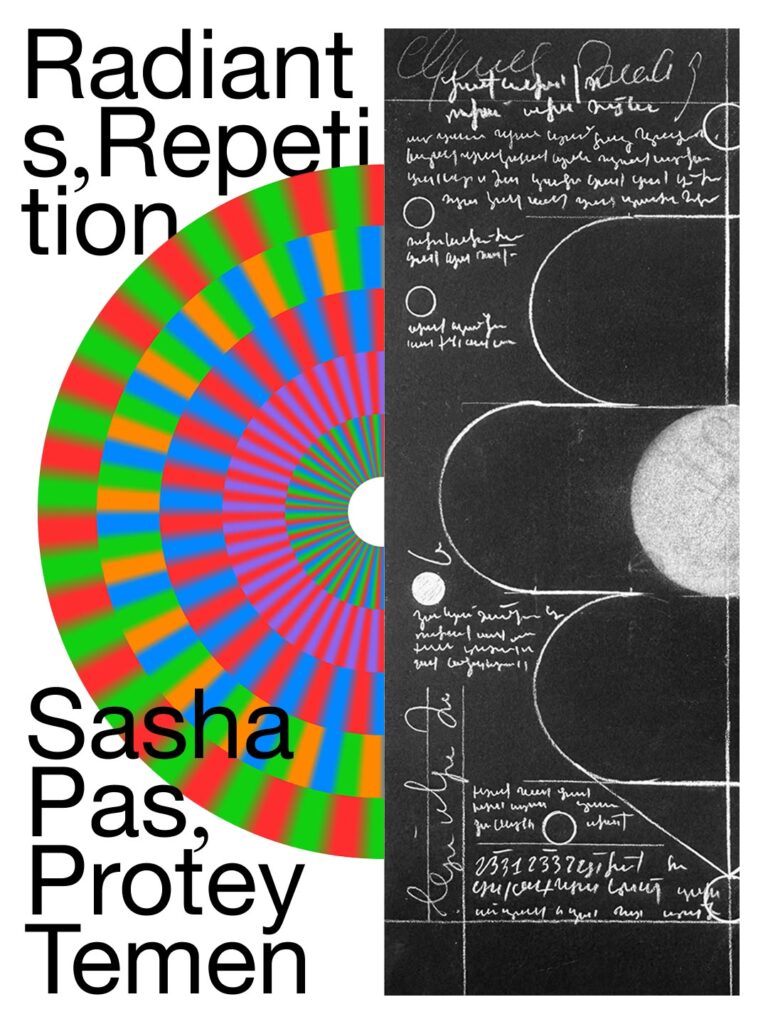
Radiants consists of a series of circular graphical scores in which colour is treated as a temporal rather than purely visual phenomenon.
Each disc combines geometric organisation with chromatic encoding to generate continuously evolving sonic structures. Read by Orbita, a colour-based circular sequencer, the scores exist simultaneously as visual compositions, performance interfaces and musical systems. Rotation transforms the image into a temporal event, allowing relationships of symmetry, repetition, interruption and gradual change to become audible. Presented together, the works investigate the circle as a compositional framework in which visual order and musical time become inseparable.
About Sasha Pas
Sasha Pas is an interdisciplinary artist working across sound, computation and interaction. His practice explores graphical notation, algorithmic composition and experimental musical interfaces, examining how geometry, colour and movement shape sonic experience. He is a member of the Can Touch This artists’ collective and co-founder of Playtronica, an artistic platform developing experimental musical instruments, participatory performances and educational programmes.
Instagram: @orbitaplaytronica
tinyurl.com/4w6dkd6p
Repetition
Repetition, rhythm, pause, emptiness, and return shape the way things become visible. They appear across different systems of notation and give form to processes that are always changing. Music unfolds in time. Images unfold in space. Both rely on intervals, repetition, variation, and silence to make change perceptible.
A notation does not simply record what already exists. It creates a way of paying attention. It leaves traces of movement, duration, and transformation without reducing them to a fixed image or a single moment.
Returning to the same gesture never produces the same result. Every repetition carries the memory of previous ones while revealing new relationships. The circle is approached as a working structure rather than a symbol: a way of returning, measuring, comparing, and noticing gradual shifts in perception.
About Protey Temen
Protey Temen’s practice is centered around using drawings, videos, books, and installations to create abstract visuals that explore and visualize the intersections between science and visual data. By utilizing the poetry of everyday life processes, he can create a deeper understanding and connection to the world around us. He sees science as a universal language, expressed through the synthetic methods of written text, calculations, and drawing. The goal of his practice is to bridge the gap between science and everyday life, encouraging viewers to question their understanding of the world and their place in it.
Instagram: @proteytemen
studiesopeninner.school