Volker Thies
CIVIL WEATHER
02.10.
Eröffnung: Fr 02.10.2026 • 19:00 Uhr
Ausstellung: 03.10. – 11.10. • Mi – Sa 15:00 – 19:00 Uhr
english below
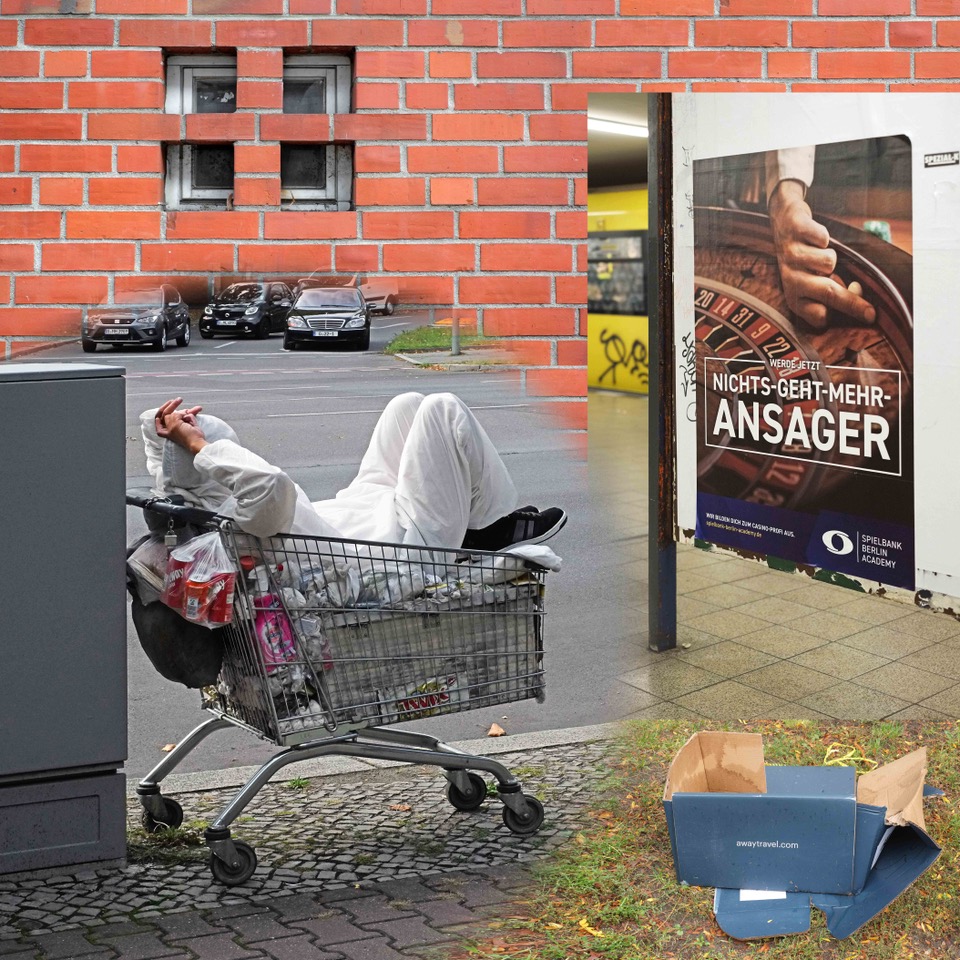
Ein Obdachloser im Schutzanzug, mit mobilem Hab und Gut. Die ängstliche Postmoderne vermauert den Blick. Die Stadt wirbt für ihre Endzeitspiele. Wer weg kann, ist längst weg, hat keinen Koffer mehr in Berlin, sondern irgendwo einen leeren Karton hinterlassen.
Woher weht der Wind in dieser zivilen Wetterlage?
„Civil Weather“ ist eine fotografische Collage aus Volker Thies’ seit 15 Jahren wachsendem Projekt „Boulevard & Widerrede“. Thies sammelt Bilder, in denen die Stadt selbst zu Wort kommt: auf Werbeplakaten und in politischen Botschaften, an Hausfassaden und in architektonischen Details, ebenso wie in beiläufigen Szenen des öffentlichen Lebens.
Seine fotografische Praxis folgt dabei einer Logik des städtischen Fundstücks. Das scheinbar Nebensächliche, Übersehene und Vorübergehende wird aus dem Strom des Alltäglichen herausgelöst und als Bild aufbewahrt. Reklame, Fassaden, Warenästhetik, politische Parolen, Gebrauchsspuren und menschliche Randlagen treten aus ihrem ursprünglichen Zusammenhang heraus und werden zu Fragmenten einer urbanen Wirklichkeit. Nicht das einzelne Bild trägt die ganze Aussage; Bedeutung entsteht in der Nachbarschaft der Bilder.
In dieser Form des Sehens liegt eine eigentümliche Nähe zu jener Großstadt-Diagnostik, die Walter Benjamin im „Passagen-Werk“ entwirft: Die Moderne lässt sich nicht allein aus ihren großen Erzählungen lesen, sondern aus ihren Oberflächen, Resten, Warenbildern, architektonischen Formen und beiläufigen Erscheinungen. Die Stadt wird zum Text, dessen gesellschaftliche Spannungen sich gerade dort ablagern, wo sie zunächst unscheinbar erscheinen. Thies schreibt sich in diese Tradition ein, ohne sie zu illustrieren. Seine Montage macht aus dem urbanen Material ein Erkenntnisinstrument.
Er setzt die Fundstücke so gegeneinander, dass ihre Widersprüche hervortreten. Was einzeln beiläufig oder vertraut erscheint, verändert seine Bedeutung im Zusammenspiel mit dem nächsten Bild: Werbung trifft auf Obdachlosigkeit, Zukunftsversprechen auf Verfall, Schutz auf Bedrohung, Konsum auf Verlust. Die Bilder behaupten dabei keine geschlossene Wirklichkeit. Sie erzeugen eine Konstellation, in der disparate Zeiten, soziale Räume und Bedeutungen für einen Augenblick gleichzeitig sichtbar werden.
Gerade darin liegt die politische Spannung der Montage. Das Bild der Stadt entsteht nicht aus dem, was sie über sich selbst erzählt, sondern aus dem, was zwischen ihren Selbstbildern sichtbar wird. Ihre Versprechen stehen neben ihren Ausschlüssen, ihre Zukunftsbilder neben den Spuren des Zerfalls. Das Neue erscheint nicht als Überwindung des Alten, sondern als dessen Nachbarschaft. Fortschritt und Verlust, Sicherheit und Prekarität, Mobilität und Verdrängung sind keine getrennten Zustände; sie gehören derselben urbanen Gegenwart an.
„Civil Weather“ bezeichnet deshalb weniger ein bestimmtes Klima als eine gesellschaftliche Atmosphäre. Das Wetter der Stadt ist in ihren Bildern eingeschrieben: in den Versprechen der Werbung, in den Schutzvorrichtungen ihrer Architektur, in den Gesten des Konsums, in den Spuren des Verfalls und in den Körpern derer, die aus ihren Ordnungen herausfallen. Die Stadt erscheint als ein Wahrnehmungsraum, in dem sich soziale Zustände atmosphärisch verdichten.
Die Collagen erzählen keine lineare Geschichte und liefern keine eindeutige Botschaft. Sie halten ihre Widersprüche offen. Ihre Wirkung entsteht aus dem kurzen Moment, in dem zwei Bilder aufeinanderstoßen und etwas sichtbar wird, das keines von beiden allein hätte sagen können. Die Montage produziert keinen Zusammenhang, den es zuvor gegeben hätte; sie stellt eine Beziehung her, in der Gegenwart als Spannung lesbar wird.
So wird die Stadt selbst zum Material einer kritischen Wahrnehmung. Thies sammelt ihre Bilder nicht, um sie zu dokumentieren, sondern um ihre Selbstverständlichkeiten aus dem Gleichgewicht zu bringen. Er verschiebt die Dinge geringfügig – und mit ihnen verschiebt sich der Blick.
Der in Berlin lebende Künstler Volker Thies, 1957 in Nienburg/Weser geboren, studierte Anfang der 1980er-Jahre an der Hochschule für Bildende Künste Braunschweig.
Zunächst in den Bereichen Zeichnung und Malerei tätig, begann er Ende der 1990er-Jahren, sich zunehmend mit Video und Super-8-Film auseinanderzusetzen. Seit rund 25 Jahren liegt sein künstlerischer Schwerpunkt auf der Fotografie.
_________________
A homeless man in a protective suit, with his few belongings. Anxious postmodernism blocks the view. The city promotes its end-of-days spectacles. Those who can leave have long since gone; they no longer have a suitcase in Berlin, but have left an empty cardboard box somewhere.
Which way is the wind blowing in this ‘civil weather’?
“Civil Weather” is a photographic collage drawn from Volker Thies’s project “Boulevard & Widerrede”, which has been evolving for 15 years. Thies collects images in which the city itself has its say: on advertising posters and in political messages, on building façades and in architectural details, as well as in casual scenes of public life.
His photographic practice follows a logic of the urban found object. The seemingly trivial, the overlooked and the transient are extracted from the flow of everyday life and preserved as images. Advertisements, façades, the aesthetics of commodities, political slogans, signs of wear and tear, and the margins of human existence step out of their original context and become fragments of an urban reality. It is not the individual image that carries the entire message; meaning arises from the interplay between the images.
This way of seeing shares a peculiar affinity with the analysis of the metropolis outlined by Walter Benjamin in the ‘Passagen-Werk’: modernity cannot be understood solely through its grand narratives, but through its surfaces, remnants, images of commodities, architectural forms and casual phenomena. The city becomes a text in which social tensions are deposited precisely where they initially appear inconspicuous. Thies situates himself within this tradition without merely illustrating it. His montage transforms urban material into an instrument of insight.
He juxtaposes the found objects in such a way that their contradictions come to the fore. What appears, taken individually, to be incidental or familiar shifts in meaning when juxtaposed with the next image: advertising meets homelessness, promises of the future meet decay, protection meets threat, consumption meets loss. The images do not claim to represent a self-contained reality. They create a constellation in which disparate times, social spaces and meanings become simultaneously visible for a moment.
It is precisely here that the political tension of the montage lies. The image of the city does not arise from what it tells us about itself, but from what becomes visible between its self-portrayals. Its promises stand alongside its exclusions, its visions of the future alongside the traces of decay. The new does not appear as an overcoming of the old, but as its neighbour. Progress and loss, security and precarity, mobility and displacement are not separate states; they belong to the same urban present.
‘Civil Weather’ therefore refers less to a specific climate than to a social atmosphere. The city’s weather is inscribed in its images: in the promises of advertising, in the protective features of its architecture, in the gestures of consumption, in the traces of decay, and in the bodies of those who fall outside its established orders. The city appears as a space of perception in which social conditions condense into an atmosphere.
The collages do not tell a linear story nor do they convey a clear message. They leave their contradictions open. Their effect arises from the fleeting moment in which two images collide and something becomes visible that neither could have conveyed on its own. The montage does not produce a connection that existed beforehand; it establishes a relationship in which the present becomes legible as tension.
In this way, the city itself becomes the material for critical perception. Thies collects its images not to document them, but to disrupt the taken-for-granted nature of the city. He shifts things ever so slightly – and with them, the viewer’s perspective shifts.
The Berlin-based artist Volker Thies, born in Nienburg/Weser in 1957, studied at the Braunschweig University of Art in the early 1980s.
Initially working in the fields of drawing and painting, he began to focus increasingly on video and Super 8 film in the late 1990s. For around 25 years, his artistic focus has been on photography.